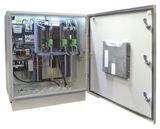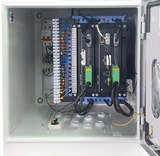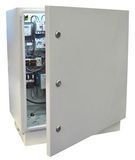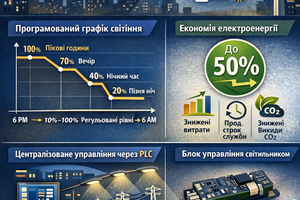
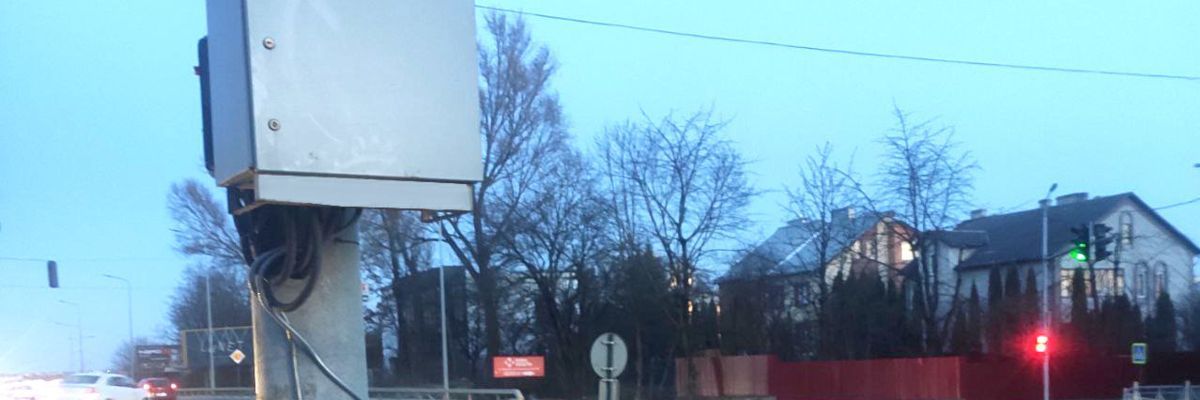
In today’s conditions, traffic management requires not only reliability but also flexibility. That’s why Electronic Technologies of Ukraine LLC (ETU) has developed the RTC series of traffic controllers, which provide automated control of traffic lights, street lighting, and other infrastructure components—both as part of centralized traffic management systems and in standalone mode.
In this article, we briefly review three in-house manufactured models: RTC-01, RTC-02, and RTC-03, highlighting their purpose, features, and key differences.
Versatile Capabilities Across All Models
RTC controllers support:
-
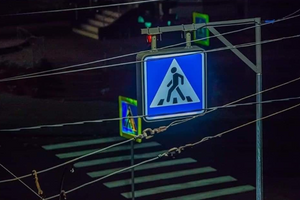
Control of vehicle and pedestrian traffic lights
-
Integration with traffic detectors (e.g., TrafiOne)
-
Support for countdown timers
-
Operation with variable message road signs
-
Multiple control modes: local, coordinated, dispatcher, and manual
-
Automatic phase switching, bulb failure monitoring, and emergency fallback to flashing yellow
-
Protection against short circuits, lightning surges, and unauthorized access
Comparison of RTC-01, RTC-02, and RTC-03 Models
| Model | RTC-01 | RTC-02 | RTC-03 |
|---|---|---|---|
| Application | Full-featured intersections, ATMS | Local signalized sites | Complex traffic hubs, reversible lanes |
| Max Output Channels | up to 32 | up to 16 | up to 72 |
| Max Input Channels | up to 16 | up to 8 | up to 24 (with expansion) |
| Cabinet Dimensions (mm) | 640 × 360 × 720 | 400 × 360 × 480 | 800 × 360 × 1080 |
| Backup Power Supply | up to 1 hour | optional | up to 1 hour |
| Enclosure Protection | IP54, Class I | IP54, Class I | IP54, Class I |
| Communication Interfaces | Ethernet, GSM/GPRS, GPS, RS-232/485 | Ethernet, GSM/GPRS | Ethernet, 3G/4G, RS-232/485 |
Which Controller Should You Choose?
-
RTC-01 – the ideal solution for standard urban intersections with integration into centralized traffic control systems (ATMS).
-
RTC-02 – a cost-effective and technically balanced model for individual intersections or pedestrian crossings.
-
RTC-03 – the most advanced option with extended capabilities, suitable for complex traffic hubs that require a scalable management system.
Conclusion
RTC traffic controllers are a reliable platform for deploying modern signal control systems. Thanks to their modular design, flexible configurations, and support for advanced technologies, these devices can handle projects of any scale—from isolated crossings to large-scale corridors with green wave synchronization.
If you're planning to upgrade your traffic signal infrastructure, ETU specialists will help you choose the best solution tailored to your specific site.
🔧 For detailed technical specifications, compliance certificates, or to access full documentation for RTC controllers, please contact the technical support department of the manufacturer — Electronic Technologies of Ukraine LLC (ETU).