In modern urban infrastructure projects, energy efficiency is not merely an advantage — it is a strategic requirement. One of the most effective tools for reducing electricity consumption in outdoor lighting systems is LED luminaire dimming — programmable power regulation based on time of day and seasonal conditions.
What Is LED Dimming and Why Is It Important?
Dimming is a technology that adjusts the luminous flux of an LED luminaire by regulating its power level. In outdoor (street) lighting systems, this enables:
-
Reduced energy consumption during low-traffic hours
-
Extended luminaire lifetime
-
Lower grid load
-
Optimized operational expenditures for municipalities and industrial facilities
Programmable Lighting Profiles
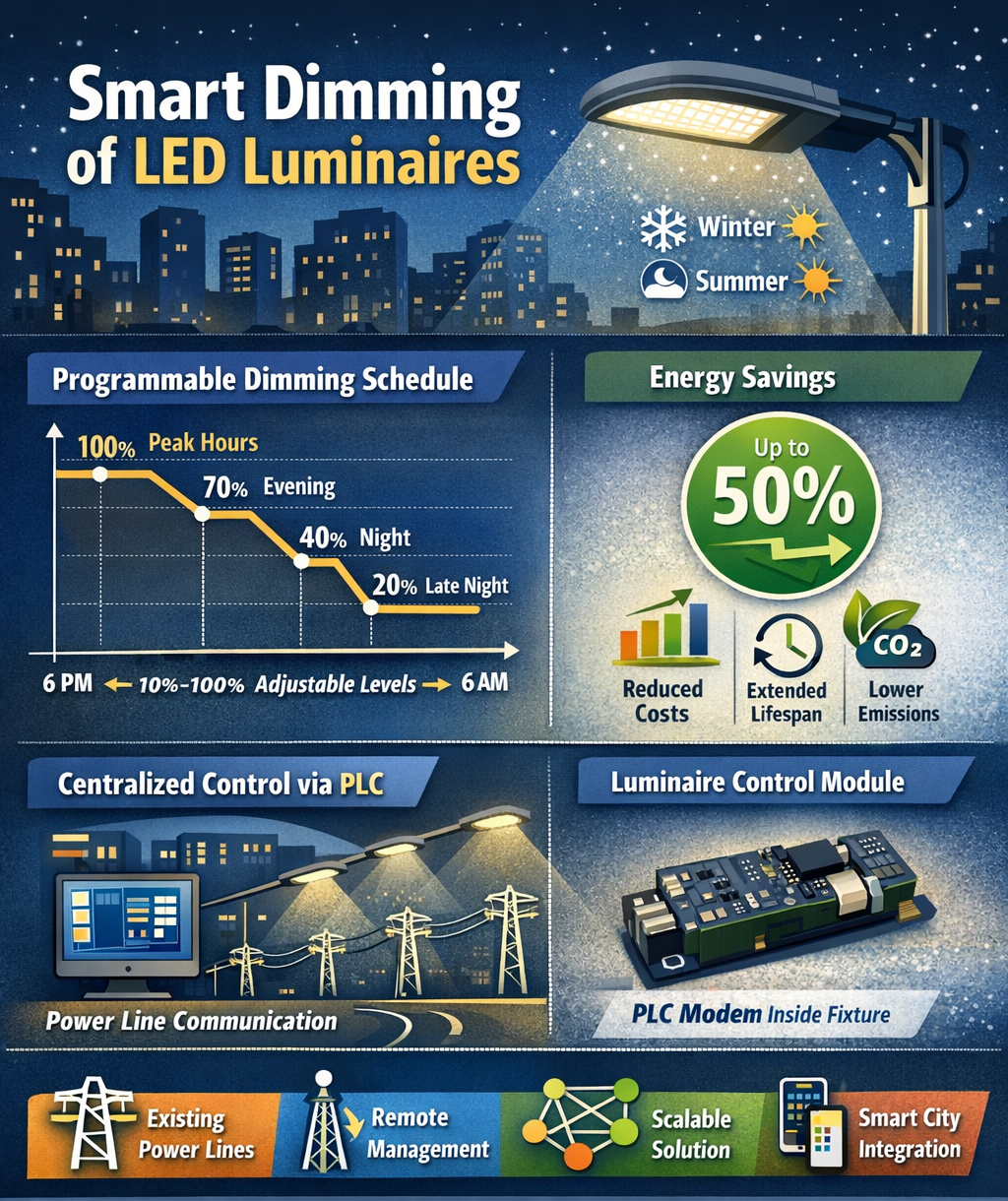
Modern systems allow up to 5 programmable power levels within a range of 10% to 100% of nominal output.
This enables flexible lighting scenarios, for example:
-
100% — peak traffic hours
-
70% — evening operation
-
40% — late-night low activity
-
20–30% — pre-dawn minimal load
Automatic Seasonal Adjustment
The system supports automatic winter/summer adaptation, adjusting operating schedules according to daylight duration without manual reconfiguration.
Centralized Control via PLC Technology
For large-scale lighting networks, dimming is implemented using PLC (Power Line Communication) modems. This technology enables data transmission over existing power lines, eliminating the need for additional communication cabling.
The automated control system based on SEA SUGO is designed for:
-
Centralized power level control of outdoor luminaires
-
Real-time dispatch and monitoring
-
Remote adjustment of lighting modes
-
Integration into municipal infrastructure management platforms
This solution is particularly effective for:
-
Urban streets
-
Highways and roads
-
Industrial zones
-
Enterprise territories
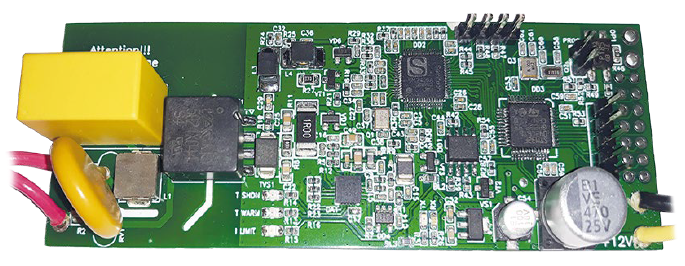
Luminaire Control Module by LEDsvit
To enable group-based luminaire management, a compact internal control unit is installed directly inside the fixture.
Hardware Configuration
The control module consists of:
-
PLC modem
-
Power supply unit
Internal installation preserves the luminaire’s ingress protection rating and mechanical integrity.
Technical Specifications
| Parameter | Value |
|---|---|
| PCB Dimensions | 99 × 35 × 20 mm |
| Supply Voltage | 12 V |
| Frequency Range | 95–125 kHz (CENELEC B) |
| Modulation | OFDM |
| Communication Standard | G3-PLC |
| Compliance | DSTU EN 500065-1:2017 |
The frequency range complies with CENELEC B requirements for low-voltage power line communication systems.
Key Advantages of PLC-Based Dimming
-
No additional communication infrastructure required — existing power lines are used.
-
Scalability — efficient group control of luminaires.
-
Energy savings of 30–50%, depending on operational scenarios.
-
Centralized supervisory control via dispatch center.
-
Smart City integration capability.
Practical Impact for Municipalities and Businesses
With rising energy costs, dimming is no longer an optional feature — it is a strategic cost-optimization instrument.
Implementing programmable lighting schedules allows organizations to:
-
Reduce electricity expenditures
-
Lower carbon footprint
-
Improve infrastructure manageability
-
Align with modern energy-efficiency standards
Conclusion
LED luminaire dimming combined with PLC-based control represents a mature and scalable solution for contemporary outdoor lighting systems.
The integration of programmable power levels, automatic seasonal adaptation, and centralized management via SEA SUGO enables maximum energy efficiency without increasing infrastructure complexity.